
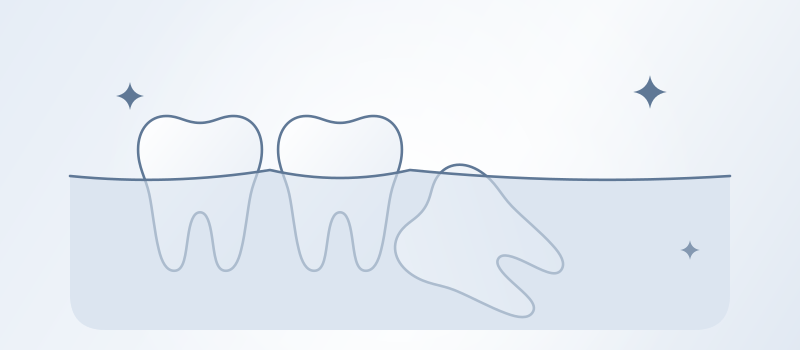
A wisdom tooth does not always need to be removed: a straight, healthy tooth that is easy to clean can stay. Removal is done under local anesthesia: you feel pressure, but there should be no pain. Swelling and aching are usually worst on day 2–3 and then ease off. Stitches are usually removed after a week. In the first days, do not smoke, drink through a straw, rinse your mouth vigorously or warm your cheek.
The wisdom tooth is the third and furthest back molar, also called the eighth tooth. It usually erupts between the ages of 17 and 25, but sometimes it never erupts or grows at an angle. The doctor decides whether to remove it after an examination and a 3D scan. This article answers the questions our patients ask most often.
1Do you need to remove a wisdom tooth?
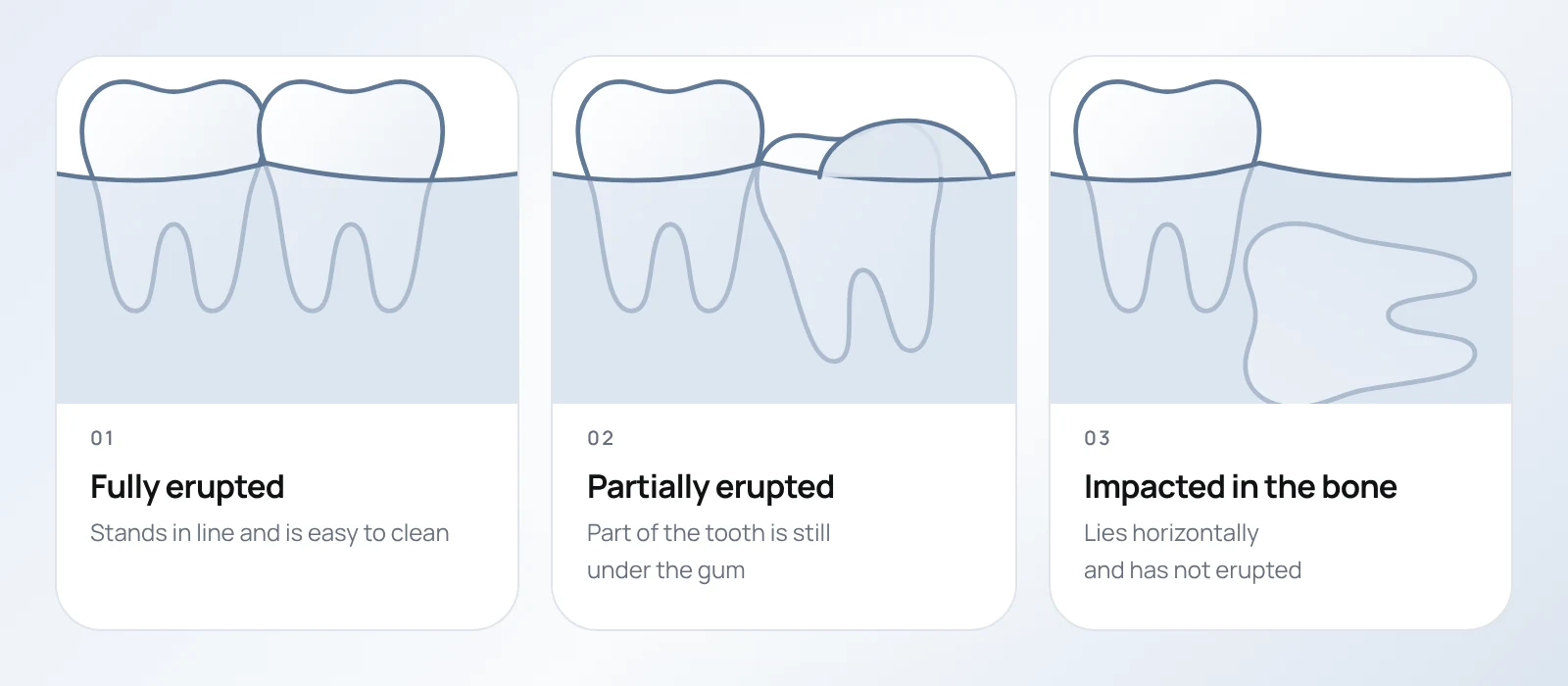
Not always. If the wisdom tooth has erupted straight, meets the tooth opposite, can be cleaned properly and there is no inflammation around it, it stays. Removal is recommended when the tooth is already causing problems or the scan shows that it will.
When the doctor recommends removing a wisdom tooth
- The gum over the tooth keeps getting inflamed. If the tooth has only partly erupted, food and bacteria collect under the overhanging gum (the “hood”). Sometimes removing the hood is enough to keep the tooth. The doctor decides.
- The tooth is destroyed by caries, and it cannot be treated or is hard to reach with instruments.
- The tooth pushes against its neighbor. Food gets stuck between them, the neighboring tooth can develop caries, and the pressure can start to damage its root.
- The tooth grows towards the cheek and keeps injuring it.
- The scan shows a cyst around an unerupted tooth.
- Removal is part of the treatment plan, for example before braces or prosthetics, if the orthodontist or prosthodontist decides so.
When a wisdom tooth can stay
If the tooth has not erupted, nothing bothers you and the scan shows no changes, it is often simply monitored at regular check-ups. There is no need to remove a healthy tooth that is not causing problems “just in case”. A wisdom tooth can even come in handy, for example as a support for a prosthesis if the neighboring tooth is lost.
Signs it is time to see a doctor
- pain or a feeling of pressure behind the last tooth;
- the gum over the tooth is swollen and hurts when pressed;
- an unpleasant taste or smell in the mouth that does not go away after brushing;
- it hurts to open your mouth or swallow;
- food keeps getting stuck behind the last tooth.
2When is the best time to remove a wisdom tooth?
If the doctor has already said the tooth is a problem, it is better not to postpone removal: over time such a tooth can damage its neighbor, and the inflammation can come back. At a young age, up to about 25, removal and healing are usually easier: the roots are often not yet fully formed.
Choose a day so that you can spend the next 2–3 days quietly: no sports, sauna or important meetings. If you are in Batumi for a short time, keep in mind that the check-up is usually about 3 days later and stitches are usually removed after a week. It is easiest to agree on the dates with the doctor in advance. How to plan treatment during a trip is covered in the article “Can I come to Batumi just for dental treatment?”.
Tell the doctor in advance if you are pregnant, take medicines that affect blood clotting or have chronic diseases. The plan and timing of the removal may depend on this.
3Does wisdom tooth removal hurt?
Not during the removal. We remove teeth under local anesthesia: you feel touch and pressure, but there should be no pain. First we apply a numbing gel, then give an injection with SuperPen or the VibraJect attachment, so you barely feel the injection itself. Classic anesthesia is also available.
Once the anesthesia wears off, the socket usually aches for a few days. The doctor will tell you how to relieve the pain. More about how we numb the area is in the article “Does dental treatment hurt?”.
4How wisdom tooth removal works
Wisdom tooth removal is a small surgical operation in the dental chair. It is done by a surgeon under local anesthesia after studying a 3D scan. One tooth or several can be removed in one visit.
- 1Examination and 3D scanThe doctor examines the tooth and gives you a referral for a 3D scan (CBCT) at our partner center Prime Dent. The scan shows how the roots are positioned and how close they are to the nerve of the lower jaw or to the maxillary sinus. You get the scan on a disc and bring it to your appointment.
- 2PlanThe doctor explains how complex the removal will be and how many teeth it makes sense to remove in one visit: one, several or all four at once.
- 3AnesthesiaA gel, then an injection with SuperPen or the VibraJect attachment. The doctor starts only when the numbness has fully set in. Classic anesthesia is also available.
- 4RemovalAn erupted tooth is usually removed whole. If the tooth is under the gum or grows at an angle, the surgeon makes a small incision in the gum and sometimes divides the tooth into parts to remove it gently without touching the neighboring teeth.
- 5Sponge and stitchesWe place a collagen sponge in the socket: it helps stop the bleeding and protects the clot from which the socket heals. Then we put in stitches.
- 6Aftercare and check-upThe doctor explains how to care for the socket and prescribes medicines if needed. The check-up is usually about 3 days later, and stitches are usually removed after a week. If anything worries you, you can message the doctor directly.
Video: three wisdom teeth in one visit
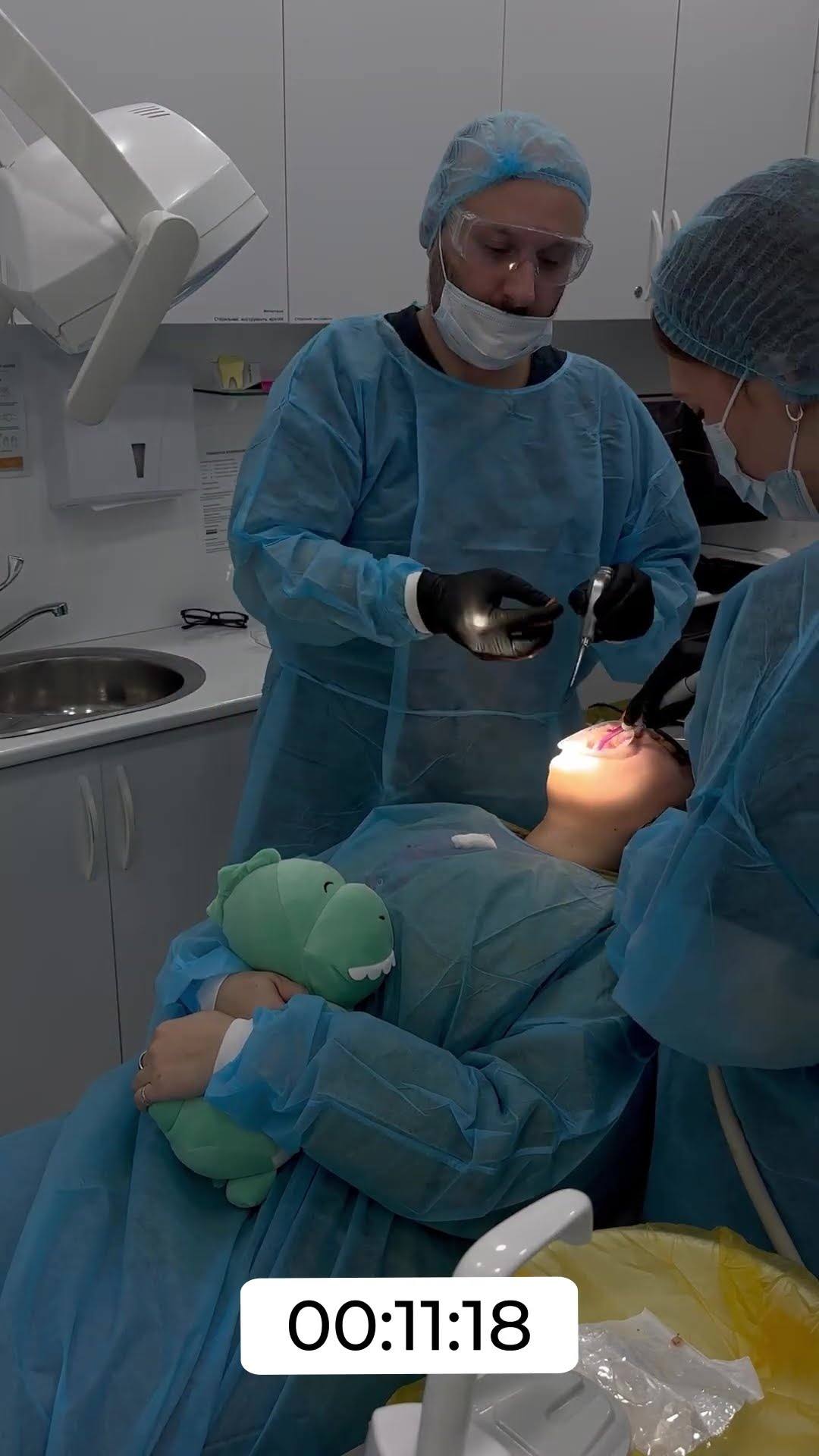
Implant surgeon Irakli Antia removes three wisdom teeth from one patient in a single visit. The operation took 23 minutes 28 seconds; in the video it is sped up. The patient is a clinic employee who gave written consent to publication.
Time in the chair depends on how the teeth are positioned, so it is different for every patient. It is shortened by the 3D scan, which lets the surgeon see the roots in advance, and by experience with such operations.
5How long does the socket take to heal after wisdom tooth removal?
The worst is usually over in 3–4 days, and by the end of the first or second week the socket hardly bothers you. The gum over the socket closes in 3–4 weeks; the bone inside recovers over several months, but you will not notice it. After a complex removal, healing takes longer.
6What to do after wisdom tooth removal
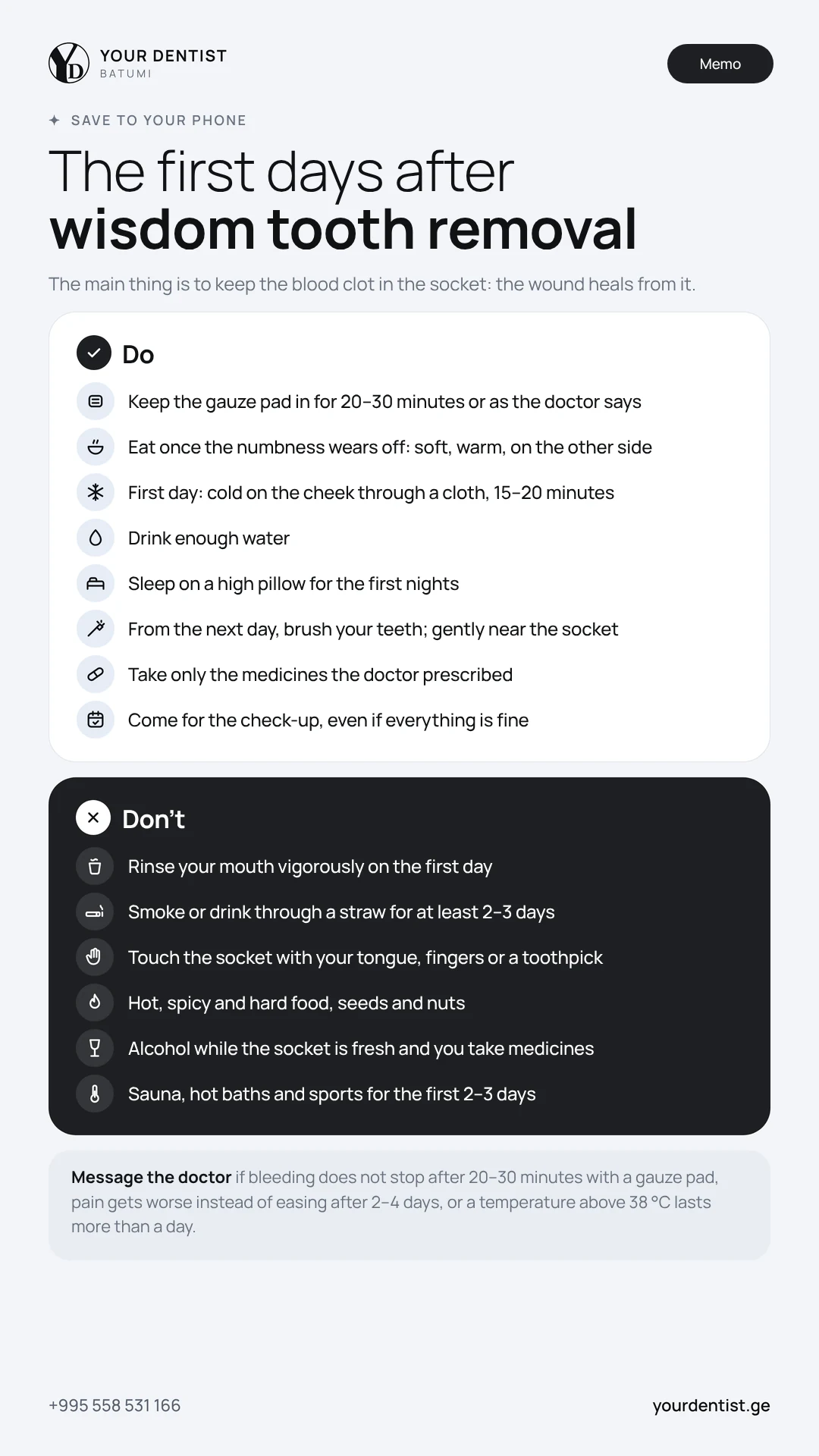
The main thing in the first days is to keep the blood clot in the socket: the wound heals from it. Here is what helps.
- Keep the gauze pad in as long as the doctor says, usually 20–30 minutes.
- Do not eat until the numbness wears off, so you do not bite your cheek or tongue. Then choose soft, warm food and chew on the other side.
- On the first day, apply something cold wrapped in a cloth to the outside of your cheek for 15–20 minutes at a time, with breaks.
- Drink enough water.
- Sleep on a high pillow for the first nights; this reduces swelling.
- From the next day, brush your teeth as usual, but gently near the socket.
- Take only the medicines the doctor prescribed. Not everyone needs antibiotics: the doctor prescribes them only when indicated.
- Come for the check-up, even if everything is fine.
7What not to do after wisdom tooth removal
In the first days, avoid anything that can wash out or pull the clot out of the socket or increase bleeding.
- Rinsing your mouth vigorously on the first day. If the doctor prescribes mouth baths, simply hold the solution in your mouth and spit it out gently.
- Smoking, including e-cigarettes, and drinking through a straw. The suction can pull the clot out of the socket. Do not smoke for at least 2–3 days, preferably longer.
- Touching the socket with your tongue, fingers or a toothpick.
- Eating hot, spicy or hard food and anything that gets stuck in the socket: seeds, nuts, crumbs.
- Drinking alcohol while the socket is fresh and while you are taking medicines.
- Warming your cheek, going to a sauna, taking a hot bath or exercising for the first 2–3 days.
8When to see a doctor urgently
Aching, mild swelling and pink saliva in the first days are normal healing. Message the doctor or call the clinic if:
- the bleeding does not stop even though you have pressed a gauze pad firmly to the socket for 20–30 minutes;
- after 2–4 days the pain does not ease but gets worse and spreads to the ear or temple, and the socket looks empty and smells unpleasant. This happens with inflammation of the socket (alveolitis), which the doctor treats;
- the swelling keeps growing after the third day;
- a temperature above 38 °C lasts more than a day;
- numbness of the lip, chin or tongue has not gone by the next day.
9How much does wisdom tooth removal cost?
Wisdom tooth removal costs the same whether the tooth has erupted or not. The price is per tooth: if several teeth are removed in one visit, each is paid for separately. The price includes anesthesia, a collagen sponge and stitches. The check-up and stitch removal are free. The 3D scan is paid separately at Prime Dent according to its price list. There is a 5% discount for cash payment.
What else is included in an extraction and prices for other types of extraction are on the page “Tooth extraction in Batumi” and in the full price list.
10FAQ
Yes. The doctor decides together with you, based on the 3D scan, how many teeth to remove per visit: one, several or all four. If you have teeth removed on one side, you can chew on the other side while it heals.
Yes. With a 3D scan (CBCT) the surgeon sees in advance the shape and position of the roots and the distance to the nerve and the maxillary sinus. The scan is done at our partner center Prime Dent with a referral from the doctor or administrator. You get it on a disc and bring it to the clinic.
It depends on the position of the tooth. An erupted tooth is usually removed in a few minutes; a complex removal takes longer. In our video, the surgeon removes three wisdom teeth in 23 minutes 28 seconds, but the time is different for every patient.
When the numbness wears off, usually after a few hours. For the first days, choose soft, warm food and chew on the other side.
The later the better, and not earlier than 2–3 days. A puff, like drinking through a straw, can pull the blood clot out of the socket, and smoking slows healing.
Not always. The doctor prescribes antibiotics only when indicated, based on your situation. Do not take them on your own “just in case”.
Usually not. The wisdom tooth is the last one in the row, and chewing is comfortable without it, so it is not replaced.
Yes, but it is better to plan the dates in advance. The check-up is usually about 3 days later, and stitches are usually removed after a week. If you are in Batumi for a short time, tell the doctor before the removal: they will adjust the plan to your dates.
11Read also
Is a wisdom tooth bothering you?
Book a consultation: the doctor will examine the tooth, give you a referral for a 3D scan and tell you whether it needs to be removed. We are open daily from 10:00 to 22:00 and speak Russian, English and Georgian.